
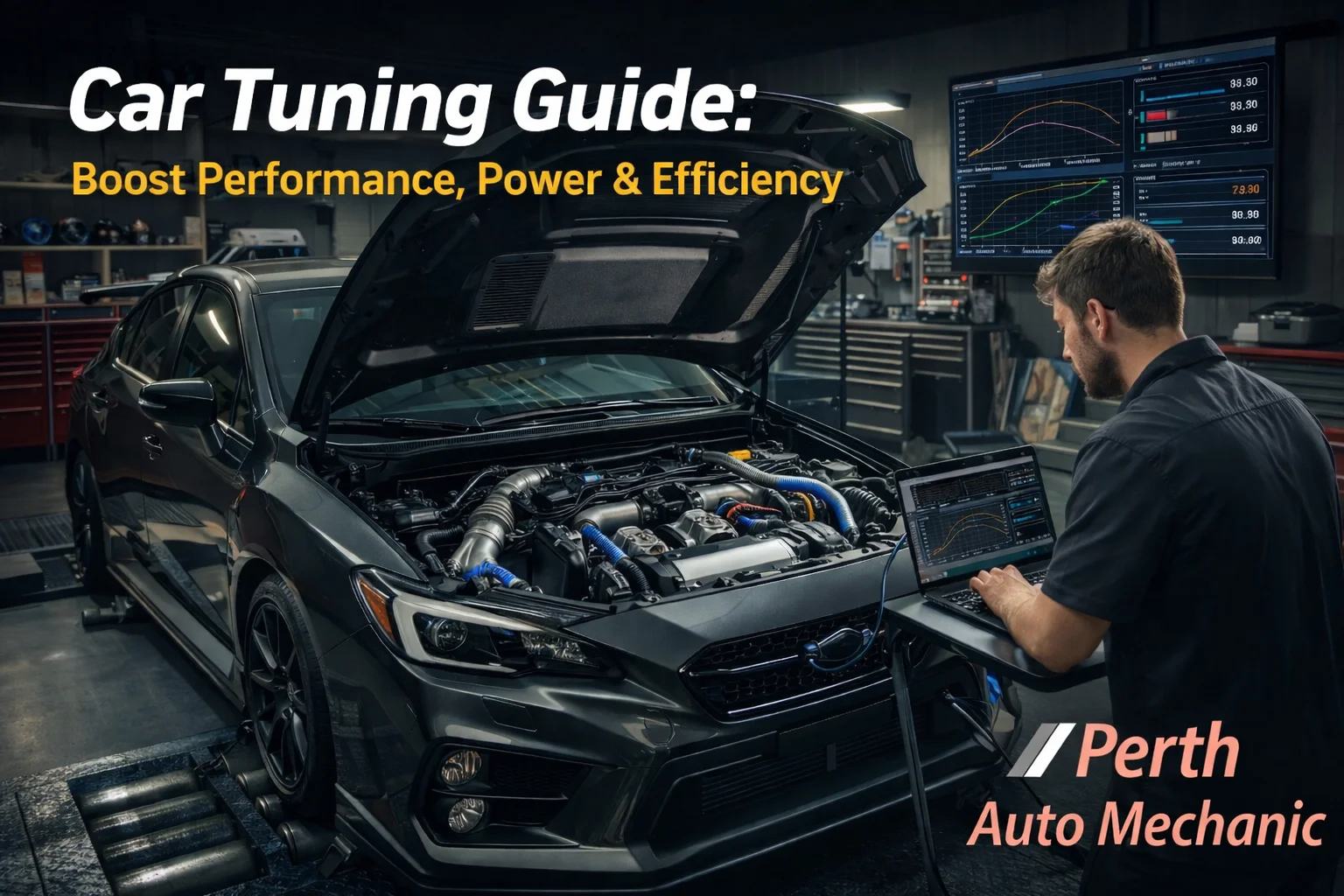
The Complete Car Tuning Guide for Perth Drivers: ECU, Dyno & Safe Performance Upgrades
Ever pressed the accelerator and felt like your car should have more to give?
You’re not alone. Many Perth drivers feel their ride isn’t performing at its full potential, whether it’s sluggish acceleration, weak towing power, or just a lack of responsiveness. That’s where professional car tuning comes in.
Car tuning is the professional optimisation of your engine, software, and supporting components to improve performance, efficiency, and drivability beyond factory settings – without sacrificing reliability or safety.
If you’re researching car tuning, you’re probably asking: Is it worth it? What exactly does it change? Will it damage my engine? And how much does it cost in Perth?
In this complete guide, we’ll break down what car tuning really involves, the different types available, potential risks, realistic costs, and how to choose the right approach for your vehicle. So, keep reading to transform how your car feels every time you drive.
What Is Car Tuning?
Car tuning is the process of optimising or modifying a vehicle’s engine, software, handling, or appearance to improve performance, efficiency, drivability, or style beyond factory settings.
Modern car tuning can involve software upgrades like an ECU remap, mechanical modifications such as intake or exhaust upgrades, suspension improvements for better handling, or visual enhancements for a personalised look.
Car tuning allows you to safely unlock that potential — whether your goal is:
- More power and torque
- Extended engine longevity
- Better towing capability
- Improved fuel economy
- Sharper throttle response
- Enhanced handling and stability
- Personalised driving experience
- A sportier appearance
Now that you understand what car tuning really means and what it offers, let’s break down the different types of car tuning and performance modifications available.
Types of Car Tuning & Performance Modifications
When people search for car tuning near me, they’re often unsure what tuning actually includes. Is it just an ECU remap? A dyno session? Bigger turbos?
In reality, car tuning is a combination of software optimisation, mechanical upgrades, drivetrain improvements, and handling enhancements. Some drivers choose one area. Others combine multiple types for balanced performance.
Here’s a complete breakdown of every major type of car tuning in Perth.
1- ECU Remapping (Engine Software Tuning)
ECU remapping is the core of modern car tuning. It involves reprogramming your vehicle’s Engine Control Unit (ECU) – the onboard computer that controls fuel delivery, ignition timing, turbo boost pressure, throttle sensitivity, torque limits, and other performance parameters.
From the factory, vehicles are deliberately tuned conservatively. Manufacturers must account for global fuel quality, emissions regulations, extreme climate variations, and long-term durability targets. As a result, many engines operate below their true performance potential.
A professional ECU remap carefully adjusts these parameters to better suit Australian fuel quality, Perth’s climate, and your specific driving needs.
What an ECU Remap Actually Adjusts
A properly calibrated ECU tune can modify:
- Fuel injection timing and quantity
- Air–fuel ratio (AFR)
- Ignition timing
- Turbo boost pressure (for forced induction engines)
- Throttle mapping and pedal sensitivity
- Torque limiters
- Rev limits (where safe and appropriate)
These adjustments are made within safe mechanical limits to optimise how the engine performs; not just to chase bigger numbers.
Supporting Modifications for Safe Power Gains
Higher performance requires proper support systems. A high-output tune may require:
- High-flow fuel injectors
- Uprated fuel pumps
- Intercooler upgrades
- Improved cooling systems
- EGT (Exhaust Gas Temperature) monitoring for diesel engines
- Careful fuel trim calibration
Petrol turbo engines must maintain precise air-fuel ratios to avoid running lean. Diesel engines often require injector recalibration and torque mapping adjustments to maintain reliability.
ECU remapping should never be treated as a standalone “plug-in upgrade.” It must consider the vehicle’s mechanical condition and intended use.
ECU tuning is typically categorised into three levels:
| Tune Type | Description |
| Stage 1 | Software-only optimisation on a mechanically stock vehicle |
| Stage 2 | ECU remap combined with intake, exhaust, or intercooler upgrades |
| Custom Tune | Fully tailored mapping for modified engines or specialised use (e.g., towing maps) |
Modern remapping is completed through software programming via the vehicle’s diagnostic port. Unlike older “chip tuning” methods that required physical chip replacement, today’s ECU flashing allows precise, reversible calibration when performed by experienced professionals.
Before any remap is carried out, the vehicle’s overall condition should be assessed. Engine health, cooling efficiency, transmission condition, and existing fault codes must all be checked. Increasing power without verifying these systems can lead to premature mechanical issues.
And while ECU remapping forms the core of performance optimisation, the most accurate way to calibrate and verify those gains is through dyno tuning — which we’ll explore next.
2- Dyno Tuning (Performance Calibration & Verification)
Dyno tuning uses a dynamometer – a rolling road machine that measures real horsepower and torque under load. This allows tuners to adjust the ECU in real time while the vehicle is safely secured and monitored.
Unlike basic plug-in remaps, dyno tuning provides measurable data. You can see before-and-after results, air-fuel ratios, boost pressure, and power curves.
What dyno tuning includes:
- Load simulation under controlled conditions
- Live adjustment of fuel and ignition maps
- Boost control refinement for turbo vehicles
- Safety monitoring to prevent detonation or overheating
- Performance graphs showing torque and power gains
For anyone serious about performance tuning in Perth, dyno verification is the safest and most professional approach. It ensures the tune is optimised for your exact vehicle; not just a generic file.
3- Performance Hardware Upgrades
Software tuning works best when paired with physical engine upgrades. Hardware modifications improve airflow, cooling, and fuel delivery. It allows the engine to safely produce more power.
Common performance hardware upgrades include:
| Upgrade | What It Improves |
| Cold Air Intake | Increases airflow into engine |
| High-Flow Exhaust | Reduces back pressure |
| Intercooler Upgrade | Lowers intake air temperature |
| Turbocharger Upgrade | Increases boost potential |
| Performance Injectors | Supports higher fuel demand |
In Perth’s warmer climate, intercooler upgrades and cooling improvements are particularly important to maintain reliability. Hardware tuning is not just about power; it’s about supporting the engine safely under increased load.
4- Suspension & Handling Tuning
Suspension tuning makes sure your car doesn’t just have power; it uses it safely. The aim is simple. Better stability, improved cornering, and predictable behaviour whether you’re towing a trailer, tackling Perth’s suburban potholed streets, or enjoying a weekend twisty run.
Core suspension upgrades include:
- Coilovers & adjustable shocks — let you set ride height and damping so the car sits and responds how you want. Great for matching comfort vs sportiness.
- Performance springs (lowering / heavy-duty) — lower centre of gravity for handling or stiffer springs for load-carrying and tradie work.
- Sway bars & strut braces — reduce body roll and sharpen turn-in, giving more confidence mid-corner.
- Bearings, bushings & mounts — polyurethane or Delrin bushes and upgraded mounts reduce flex and keep geometry precise under load.
- Alignment & corner balancing — the invisible tune: correct alignment & corner balance turn parts into real improvements (less tyre wear, better steering).
- Tyre pairing — high-performance tyres are as important as shocks; match compound and profile to your driving goals.
- Air suspension & adjustable systems — ultimate versatility: change ride height on demand but expect higher maintenance.
If you tow or carry heavy loads, prioritise heavy-duty springs, alignment for loaded ride height, and damping tuned for heat and sustained highway driving. Off-road 4WDs benefit from longer-travel dampers and bump-stop tuning to avoid bottoming on rough tracks.
5- Brake System Upgrades
If you increase power, you must improve stopping performance. Brake tuning enhances safety, especially in vehicles used for towing, high-speed driving, or carrying heavy loads.
Brake upgrades often include:
- Performance brake pads
- Larger or ventilated brake rotors
- Braided brake lines
- High-temperature brake fluid
Upgrading brakes improves stopping distance, fade resistance, and pedal responsiveness. This is a critical but often overlooked part of complete car tuning.
6- Drivetrain & Transmission Tuning
The drivetrain transfers engine power to the wheels. When engine output increases, drivetrain components must handle the added torque.
Drivetrain tuning may involve:
- Transmission (TCU) remapping to adjust shift timing
- Upgraded clutch systems for manual vehicles
- Lightweight flywheels for faster rev response
- Limited Slip Differentials (LSDs) for better traction
- Reinforced driveshafts or axles
Without proper drivetrain upgrades, increased power can cause premature wear or failure. Smart tuning considers the whole system; not just the engine.
7- Intake & Exhaust Tuning
Exhaust and intake tuning focuses specifically on improving how air flows into and out of the engine. These modifications directly influence performance and engine efficiency.
Intake tuning may include:
- High-flow air filters
- Cold air intake systems
Exhaust tuning may include:
- Cat-back exhaust systems
- Performance headers
- High-flow catalytic converters (where compliant)
Benefits include improved throttle response, enhanced engine sound, and smoother power delivery. However, exhaust modifications in WA must comply with noise and emissions regulations — something professional workshops always consider.
8- Turbocharging & Forced Induction Tuning
Turbo and supercharger systems force more air into the engine, significantly increasing power potential. This form of tuning is common in both petrol performance vehicles and diesel 4WDs.
Forced induction tuning requires:
- Boost pressure calibration
- Fuel system support
- Cooling upgrades
- Careful air-fuel ratio monitoring
When done correctly, turbo tuning can dramatically improve torque. Ideal for towing and off-road driving in Perth conditions. But it must be approached carefully, as excessive boost without proper support can cause engine damage.
9- Engine Internal Modifications
For extreme builds, internal engine upgrades may be performed. These modifications go beyond basic tuning and involve mechanical rebuilding.
Examples include:
- Forged pistons and rods
- Increased cylinder bore (boring)
- Stroke modification
- High-performance camshafts
- Larger radiators for cooling
These are advanced performance modifications and are typically part of high-output builds rather than everyday car tuning.
10- Light Tuning (Visibility Upgrades)
Light tuning upgrades your vehicle’s lighting system to improve visibility, safety, and appearance. While primarily cosmetic, it can also enhance nighttime driving performance — especially on poorly lit Perth roads or regional WA highways.
Common light tuning upgrades include:
- LED or HID headlight conversions for brighter, more focused beams
- Upgraded fog lights or light bars for improved low-visibility driving
- Exterior accent lighting for added road presence
- Interior LED ambient lighting to enhance cabin atmosphere
Modern projector headlights improve beam control and reduce glare when professionally installed. However, all lighting modifications must comply with WA road regulations regarding brightness, colour, and positioning.
Light tuning doesn’t increase engine performance, but it completes a vehicle’s look while improving functional visibility.
11- Visual & Cosmetic Auto Tuning
Visual tuning is where personality meets craftsmanship. These changes don’t boost horsepower, but they transform how your car looks, how it’s perceived, and how you enjoy driving it. For many drivers, cosmetic upgrades are the finishing touch after mechanical tuning. They turn a tuned car into a head-turning statement.
Key cosmetic tuning components are:
- Body kits and spoilers – Sharper styling with potential minor aerodynamic benefits
- Vinyl wraps and custom paint finishes – Personalised colours, matte or metallic looks without full resprays
- Paint protection film (PPF) and ceramic coating – Long-term protection against WA sun and coastal conditions
- Interior re-trims and accents – Leather, Alcantara, contrast stitching, upgraded trims
- Audio and infotainment upgrades – Enhanced speakers, head units, and sound insulation
- Custom badges, grille treatments and trim detailing – Subtle styling that adds personality
These modifications enhance aesthetics but do not directly increase engine performance. They are often combined with mechanical tuning for a complete build.
DIY Car Tuning in Perth: Can You Tune Your Car Yourself?
Yes, you can attempt basic DIY car tuning, but professional auto tuning delivers safer, more accurate, and longer-lasting results.
With online tuning files, handheld programmers, and plug-and-play performance chips widely available, many Perth drivers consider DIY ECU remapping or bolt-on upgrades at home. Basic modifications like air filters, exhaust swaps, or entry-level ECU flash tools may seem straightforward.
However, modern vehicles are highly computerised. Today’s engines rely on precise calibration between fuel delivery, ignition timing, turbo boost pressure, emissions systems, and drivetrain torque management. Small mistakes in tuning can lead to:
- Lean fuel conditions
- Excessive exhaust gas temperatures (EGT)
- Transmission stress
- Engine knocking or detonation
- Warranty complications
Professional car tuning goes beyond uploading a generic map. Experienced workshops:
- Run full diagnostic scans before tuning
- Check cooling systems and drivetrain condition
- Perform dyno calibration under load
- Log live data (air-fuel ratio, boost, timing)
- Fine-tune maps specific to your vehicle
DIY tuning may offer short-term gains, but professional tuning ensures reliability, compliance, and long-term engine health — especially in WA’s hot climate.
And before committing to any tuning, it’s important to understand the risks involved.
Risks & Important Considerations Before Car Tuning
Car tuning can improve performance, but it must be approached responsibly.
➣ Mechanical Stress & Reliability
Increasing power increases stress on:
- Engine internals
- Turbochargers
- Clutches and gearboxes
- Cooling systems
Without proper supporting upgrades, excessive torque can shorten component lifespan.
➣ Warranty & Manufacturer Policies
Many manufacturers may void parts of your warranty if engine software is altered. Some modern ECUs log flash history, meaning a remap can be detected even if reverted.
Always clarify warranty implications before proceeding.
➣ Emissions & WA Road Compliance
In Western Australia, modifications affecting emissions systems (such as catalytic converters or DPF removal) can make a vehicle non-compliant for road use. Noise levels from aftermarket exhaust systems must also remain within legal limits.
Professional tuners understand these regulations and calibrate accordingly.
➣ Insurance Disclosure
Modifications, including ECU remapping, should be disclosed to insurers. Undeclared modifications can affect claim eligibility.
➣ Vehicle Condition Matters
Tuning a poorly maintained vehicle is risky. Issues like worn spark plugs, dirty injectors, cooling system problems, or slipping transmissions should be resolved before performance adjustments.
Now that you understand the considerations, let’s talk about one of the most common questions Perth drivers ask.
How Much Does Car Tuning Cost in Perth?
In Perth, car tuning typically costs between $700 and $2,000+ depending on the vehicle, tuning type, and whether dyno testing or hardware upgrades are required. Basic ECU remaps are on the lower end, while custom dyno tuning or performance builds cost more due to labour, diagnostics, and calibration time.
Below is a practical cost overview:
| Tuning Type | Typical Perth Price Range (AUD) |
| Stage 1 ECU Remap | $700 – $1,400 |
| Dyno Tuning Session | $5,00 – $7,00 |
| Mobile ECU Remap | $700 – $1,200 |
| Intake / Exhaust Upgrade | $500 – $3,000+ |
| Turbo Upgrade & Tune | $3,000 – $10,000+ |
| Transmission (TCU) Tune | $600 – $1,500 |
Prices vary based on vehicle make, engine type (diesel vs petrol), and level of modification.
For diesel 4WD tuning in Perth, especially for towing applications. custom torque maps and cooling checks may slightly increase costs but significantly improve long-term reliability.
Signs Your Car Needs a Professional Tuning Service
Car tuning isn’t just for performance enthusiasts. Sometimes, your vehicle itself signals that optimisation or maintenance is overdue.
Here are clear warning signs to watch for:
- Slow or difficult starting – Extended cranking may indicate ignition or fuel calibration issues.
- Reduced fuel efficiency – Filling up more often without driving extra kilometres can signal inefficient combustion.
- Rough idling or vibration – Uneven engine revs often point to fuel or spark imbalance.
- Sluggish acceleration – Hesitation under throttle may indicate sensor, air intake, or fuel delivery problems.
- Check Engine light illuminated – Stored fault codes require diagnostic scanning before performance tuning.
- Excess exhaust smoke – Blue, white, or black smoke suggests combustion imbalance or mechanical wear.
- Engine running hotter than normal – Cooling inefficiencies should be resolved before any tuning is attempted.
- Knocking or pinging sounds – Abnormal combustion requires immediate inspection.
If you notice one or more of these symptoms, a diagnostic inspection combined with a professional tune-up may restore performance, efficiency, and reliability.
Still driving a sluggish, underperforming car?
Why settle for factory limits when your vehicle is capable of more?
Upgrade Your Ride’s Performance Safely with Expert Car Tuning by Perth Auto Mechanics
At Perth Auto Mechanic, we don’t just upload generic tuning files; we deliver precision-calibrated, diagnostics-backed car tuning designed for Perth driving conditions.
Whether you want stronger towing torque, smoother acceleration, better fuel efficiency, or dyno-verified performance gains, our experienced Aussie & NZ mechanics ensure every tune is:
- Mechanically safe
- Professionally calibrated
- WA road compliant
- Tailored to your vehicle and goals
We combine advanced auto diagnostics, real-time data logging, and performance expertise to optimise your vehicle without compromising reliability.
Don’t risk your engine with guesswork or generic maps.
FAQs About Car Tuning in Perth
- What are the basic components of tuning a car?
The core components of car tuning include ECU remapping (software optimisation), dyno calibration, intake and exhaust upgrades, fuel system adjustments, suspension tuning, and drivetrain optimisation. Modern tuning focuses on balancing engine performance, reliability, and compliance rather than just increasing horsepower.
- What does an ECU remap do?
An ECU remap modifies your vehicle’s engine software to optimise fuel delivery, ignition timing, turbo boost pressure, and throttle response. This can increase power and torque, improve drivability, and enhance fuel efficiency when calibrated professionally and safely.
- What’s the difference between a standard tune and a dyno tune?
A standard tune often involves uploading a pre-configured ECU map without load testing. A dyno tune, on the other hand, calibrates your vehicle on a dynamometer under real driving loads.
- Will tuning void my warranty?
Tuning can affect manufacturer warranty coverage, particularly for engine and drivetrain components. Some modern ECUs log software changes, which can be detected even if reverted. Always consult your workshop before tuning a vehicle still under warranty.
- How long does car tuning take?
A basic ECU remap typically takes between 1–3 hours. A full dyno tuning session may take 4–8 hours depending on the vehicle and complexity. Custom builds and hardware upgrades can require additional time for installation and calibration.
- How much does a dyno tune cost in Perth?
In Perth, dyno tuning generally costs between $400 and $700 for basic sessions, while full custom dyno remapping with calibration adjustments typically ranges from $1,000 to $1,500+ depending on the vehicle and modifications.
- How much does it cost to tune a car in Perth?
The cost of tuning depends on your vehicle type and tuning level. A basic tune-up for maintenance purposes may cost $400–$800, while performance ECU remapping ranges from $700–$1,400. Advanced performance builds with hardware upgrades cost significantly more.
- When should you tune your car?
You should consider tuning when your vehicle shows signs of reduced performance, poor fuel efficiency, sluggish acceleration, or after installing performance upgrades. Always perform a diagnostic health check before tuning to ensure mechanical readiness.